


Two Easy Ways to Start Earning Rewards!
Become a member today! Members-only pricing and offers, personalized care notifications, Vital Care points back on every purchase and more!
 Become a credit card member today!
Earn 2X Pals Rewards points at Petco
when you use Petco Pay!APPLY NOWLearn More About Petco Pay Benefits
Bulldog
Updated on June 17, 2025


The Bulldog is a devoted, people-focused companion with a gentle heart and unmistakable charm. Though happy to relax at home, this breed does best with regular, low-impact activity and plenty of family time. With attentive care, Bulldogs make loving, loyal pets.
Temperament
Affectionate, Loyal, Easygoing
Colors
Red, White, Fawn, Fallow, Brindle
 WEIGHT
40 - 50 Pounds
 HEIGHT
12 - 16 Inches
 LIFE EXPECTANCY
8–10 Years
Maintenance Level
Low Maintenance
High Maintenance
Friendliness
Reserved
Extroverted
About Bulldog
Owning a Bulldog is an incredibly rewarding experience, as these are true family dogs that are devoted to their owners. Despite their rather formidable expression, the Bulldog is an affectionate breed that loves attention. They are also brilliant with children, of whom they can become quite protective.
While the Bulldog would quite happily become a couch potato if allowed, it is important that they receive a moderate amount of exercise each day in order to maintain a healthy weight and body conformation. The breed is prone to a number of health issues, and because of this they tend to require a higher than average amount of spending on veterinary care. Prospective owners should make themselves aware of these health conditions in order to not only select a dog from a good breeder who actively tries to breed healthy dogs, but also to ensure that they are prepared for the financial commitment of owning one of these dogs.
Origin: United Kingdom Other Names: Bulldog or British Bulldog
Non-Sporting Group
Non-sporting dogs are a highly diverse group, ranging widely in size, coat type, personality, and appearance. This category includes everything from compact companions to sturdy, medium-sized breeds, with coats that can be short, curly, or long and flowing. Some breeds are common household favorites, while others are less frequently seen, making the group one of the most varied in the dog world.
Breed Appearance
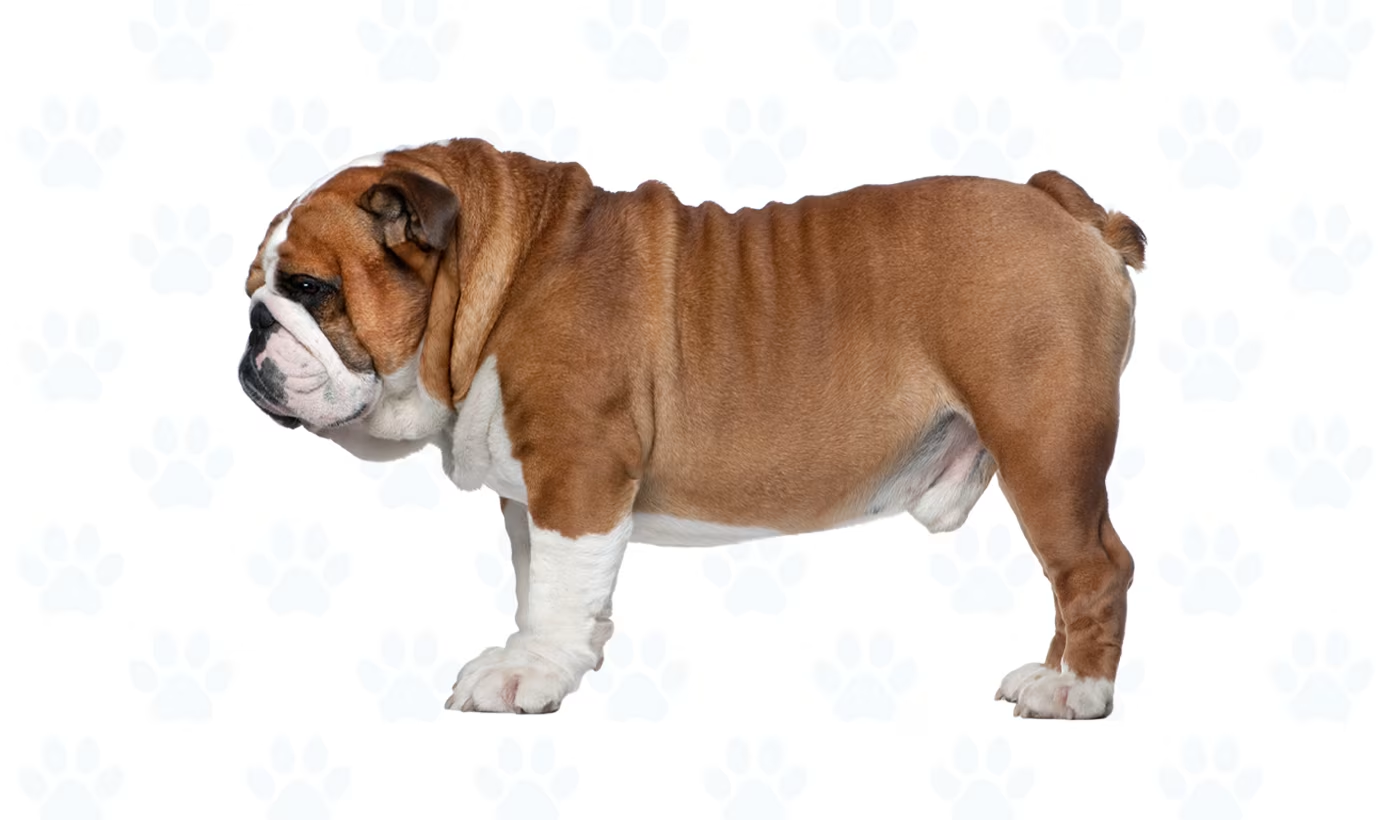
The Bulldog is a medium sized breed with a broad, powerful body, and a large head. It should be a muscular dog, but never fat. The thick legs are able to support its weight, with the overall appearance being a dog of strength. The tail is naturally short and held low and close to the body.
Bulldogs have a short coat, which is fine and glossy. The American Kennel Club (AKC) recognizes the Bulldog in several different coat colors, including red, white, fallow, fawn, or any of these colors combined together. They also recognize several patterns such as piebald, brindle, black masks, ticking, and a small portion of solid black in the piebald. While Bulldogs are found in other colors, these colors are not recognized as “standard” by the AKC.
Size & Weight
Bulldogs are medium-sized dogs. Males are slightly larger at maturity, reaching approximately 50 pounds, whereas females are typically around 40 pounds. Both sexes can measure between 12 and 16 inches at the shoulder.
Full Grown
Female
12 in. / 40 lbs.
Male
16 in. / 50 lbs.
Height is measured up to the shoulders.
Characteristics
- Size & Coat
- Lifestyle
- Training & Behavior
How to Care for a Bulldog
Caring for a Bulldog means balancing their love of relaxation with the daily routines that keep them feeling their best. With mindful exercise, consistent training, proper nutrition, and regular grooming and health care, this devoted companion can thrive as a happy, comfortable member of your family.
Cost of Owning
Savings & Rewards
Unlock exclusive rewards with Vital Care, or enjoy up to 35% off essentials when you subscribe with Autoship.

Enjoy exclusive rewards every time you shop. Get member-only deals, points, and special offers designed to help you save more on what your pet needs.

Never run out of the essentials. Subscribe and get your pet’s favorites delivered on schedule—with up to 35% off plus the convenience of automatic refills.
Cross Breeds
Select a Breed to Cross
Choose a breed from the dropdown to see potential crosses.
Bulloxer
Your love story starts here.
Find adoptable pets near you with a simple search.
Fun Facts
President Warren G. Harding had a pet Bulldog called “Oh Boy.”
Over 80% of Bulldogs are born by Caesarean section. Due to their wide shoulders and large heads, it is almost always impossible for them to be delivered naturally.
Bulldogs are popular pets with celebrities. Zac Efron, David Beckham, Reese Witherspoon, and Leonardo DiCaprio have all owned one at some point.
History
The origin of the Bulldog is rather mysterious, with many disagreeing on the breed’s beginnings. Some claim the breed was created by crossing the pug and the mastiff, while others claim it was bred from the Alaunt, an old type of mastiff seen in the 17th century. We do know that the breed originated in the British Isles.
Bulldogs were used in the cruel sport of “bull baiting.” Bull baiting involved encouraging dogs to attack a bull that was tethered on a very short line, or placed into a pit. The dogs were set on the bull one by one until the bull was rendered immobile. The Bulldog was trained to grab and hold the bull’s nose. Bulldogs were bred specifically for this purpose in 16th century England, when the sport was practiced.
Later, the Bulldog was used for dog fighting. After 1835, selective breeding took place to change the Bulldog into the flat-faced, compact dog seen today. They were first shown in 1860. The breed was recognized by the AKC in 1886 and today they are the fourth most popular breed in the US.